Christian Counseling vs. Biblical Counseling: What’s the Difference and Why It Matters for Trauma Healing
If you are a Christian woman seeking counseling, you may have noticed something confusing—and sometimes overwhelming—when searching for help.

Some therapists describe themselves as Christian counselors. Others offer Biblical counseling. Both may reference Scripture. Both may love Jesus. Both may sincerely want to help you heal.
And yet, these two approaches are NOT the same.
For women carrying childhood trauma, anxiety, emotional dysregulation, or relational wounds, the difference between Christian counseling and Biblical counseling is not just theoretical. It can deeply impact whether therapy feels safe, supportive, and genuinely healing—or unintentionally shaming and overwhelming.
This article is not about criticizing faith-based counseling approaches. It is about clarity, wisdom, and informed choice, especially if trauma is part of your story.
Why Grace Must Come First For Trauma Survivors
Trauma changes the nervous system.
It reshapes how the brain processes threat, safety, attachment, and emotion.
It often leaves women feeling hyper-vigilant, disconnected, ashamed, or “too much.”
Many Christian women already carry spiritualized guilt:
“I should be over this by now.”
“If my faith were stronger, I wouldn’t feel this way.”
“God healed others—what’s wrong with me?”
When counseling unintentionally reinforces these beliefs, even with good intentions, it can deepen the wound rather than heal it.
That is why understanding the philosophy, training, and trauma awareness behind a counseling approach truly matters.
What Is Biblical Counseling?
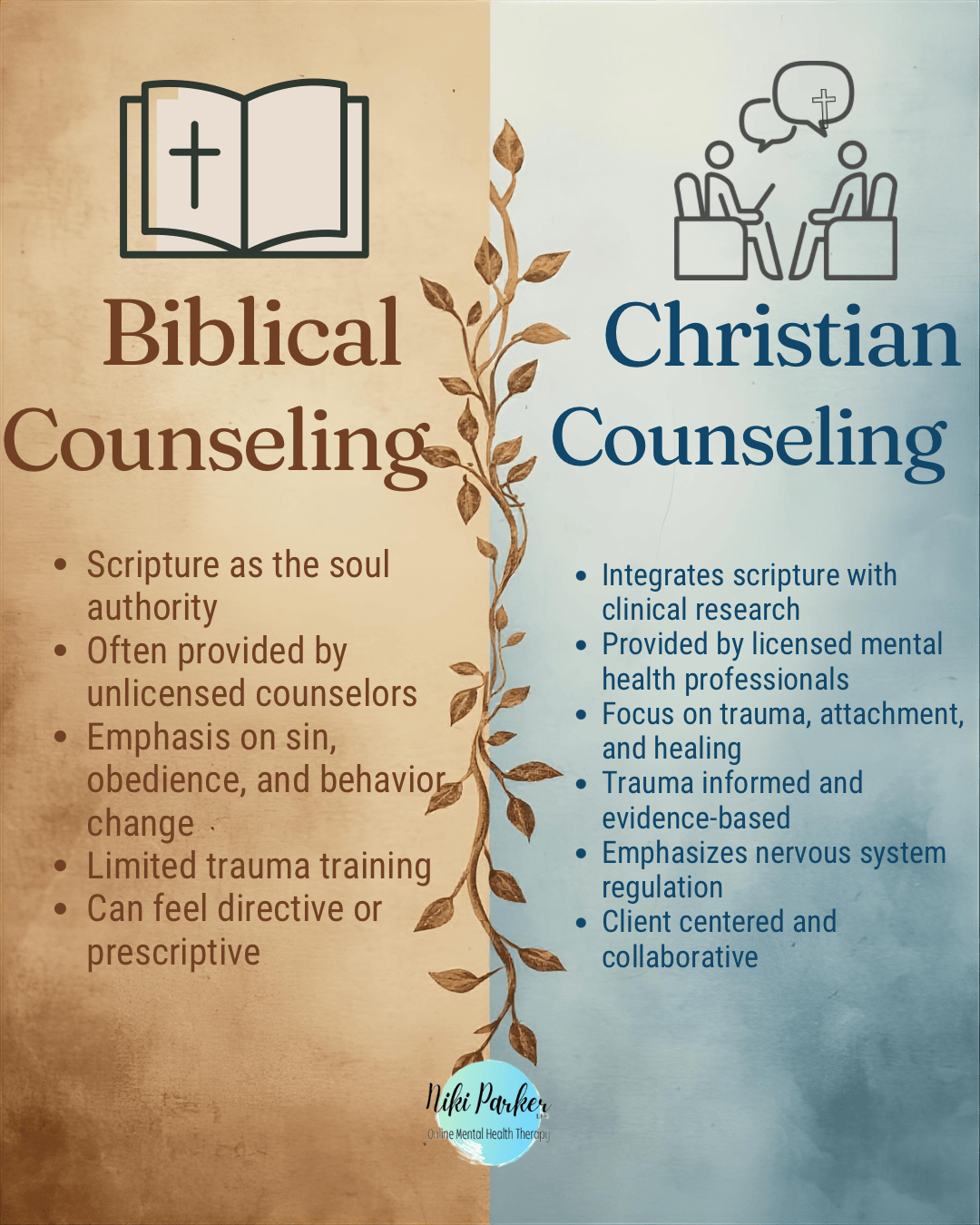
Biblical counseling is a faith-based approach rooted in the belief that Scripture alone is sufficient to address emotional, psychological, and spiritual struggles.
Core Characteristics of Biblical Counseling
While approaches vary, Biblical counseling often includes:
The Bible as the primary and sometimes exclusive authority for healing
Focus on sin, repentance, obedience, and sanctification
Minimal reliance on psychological research or clinical models
Counselors who may be Pastors or lay counselors rather than licensed clinicians
Emphasis on behavior change through spiritual discipline
Biblical counseling typically views emotional distress through a theological lens first, sometimes interpreting anxiety, depression, or relational struggles as issues of belief, obedience, or spiritual maturity.
For some believers, especially those seeking discipleship or moral guidance, this framework feels grounding and familiar.
A Personal Word: Why This Matters to Me as a Christian Counselor
I want to pause here and speak personally—not as a clinician first, but as a Christian woman who deeply loves Jesus and cares about the Church.
Several years ago, I signed up for and briefly attended a conference that taught Biblical counseling through the American Association of Biblical Counselors. I went in with an open heart, hoping to learn, to listen, and to grow. I expected thoughtful theological dialogue. What I experienced instead was deeply unsettling.
Within just a few hours, my nervous system was overwhelmed.
Licensed counseling was repeatedly spoken about with suspicion and contempt. Clinical training was framed as unnecessary or even dangerous. Emotional suffering was reduced to spiritual failure. And again and again, the message returned to some version of “you just need to pray more”—without curiosity, without education, and without compassion for how trauma actually impacts the brain and body.
As someone trained in trauma-informed care, I could feel what was happening inside me in real time. My chest tightened. My body went into fight-or-flight. Not because my faith was being challenged—but because relationship was being replaced with religious pressure, and suffering was being treated as a moral problem rather than a human one.
What struck me most was how little space there was for understanding what was happening inside a person. There was no language for the nervous system. No acknowledgment of trauma responses. No curiosity about how God designed the brain. The focus stayed fixed on individual blame rather than on compassionate redirection and healing.
I left that conference in tears.
Not because I reject Scripture.
And certainly NOT because I reject prayer.
But because I saw how easily faith can be used in a way that bypasses relationship—with God and with people. As a Christian counselor, that experience grieved me.
I share this not to attack individuals or ministries, but to name something important: when counseling ignores the nervous system, minimizes trauma, and places spiritual performance above relationship with God, it can cause real harm—even in the name of faith.
Jesus never treated wounded people this way.
He slowed down.
He noticed distress.
He responded with compassion before correction.
He healed within relationship.
That lived experience is one of the reasons I am so passionate about trauma-informed Christian counseling. I believe with my whole heart that we do not have to choose between deep faith and deep psychological care. God is not threatened by science. He is not dishonored by licensed training. And He certainly does not ask His children to bypass their pain in order to be faithful.
Healing happens when truth is offered with safety—and when God is encountered as loving, present, and kind, not distant or demanding.
Where Biblical Counseling Can Become Harmful for Trauma Survivors
Trauma is not primarily a sin issue.
It is a neurobiological injury that impacts the brain, body, and attachment system.
When trauma is addressed only through Scripture without understanding the nervous system, several risks emerge.
1. Trauma Responses Are Misinterpreted as Sin
A woman who freezes, dissociates, or avoids conflict may be told she is:
Lacking faith
Harboring unforgiveness
Being disobedient or fearful
In reality, her body may still be operating in survival mode.
2. Scripture Is Applied Without Emotional Safety
Well-meaning verses can land as:
“Submit more.”
“Forgive faster.”
“Trust God harder.”
Without pacing, attunement, and emotional regulation, Scripture can feel like pressure rather than comfort.
3. The Nervous System Is Overlooked
Trauma healing requires:
Regulation
Safety
Choice
Gradual processing
Biblical counseling often lacks training in how trauma impacts the brain and body, which can leave women feeling unseen or misunderstood, rushed into “healing” which then becomes superficially learning how to push the effects of trauma even deeper down.
What Is Christian Counseling?
Christian counseling integrates clinical psychology and Christian faith, honoring both scientific research and Biblical truth.
It recognizes that:
God created the brain and nervous system
Trauma has physiological and psychological effects
Evidence-based therapy can be a tool of God’s healing grace
Christian counseling does not replace Scripture.
It applies Scripture wisely, with clinical understanding and emotional safety.
Core Characteristics of Christian Counseling
Christian counseling typically includes:
Licensed mental health professionals
Formal training in trauma, attachment, and nervous system regulation
Evidence-based modalities such as EMDR, somatic therapy, or trauma-informed CBT
Intentional, client-led faith integration
Respect for spiritual wounds and church-related trauma
Christian counseling asks not only:
“What does Scripture say?”
It also asks:
“What has your body learned to do to survive?”
“What happened to you?”
“What does safety look like for you right now?”
Why Christian Counseling Is Often Safer for Trauma Healing
Trauma healing requires both truth and tenderness.
Christian counselors creates space for:
Emotional regulation before spiritual application
Processing pain without rushing forgiveness
Understanding symptoms without moral judgment
Integrating faith in a way that restores trust rather than fear
Trauma-Informed Faith Integration
In trauma-informed Christian counseling:
Prayer is invited, not forced
Scripture is grounding, not weaponized
God is presented as safe, present, and compassionate
Healing unfolds at the pace of the nervous system
This approach mirrors how Jesus engaged wounded people—never rushing, never shaming, never minimizing suffering.
EMDR and Trauma-Informed Christian Counseling
Many Christian counselors are trained in EMDR (Eye Movement Desensitization and Reprocessing), a highly researched trauma therapy.
EMDR allows the brain to reprocess traumatic memories so they no longer feel overwhelming or present-day.
For Christian women, EMDR can:
Reduce emotional intensity tied to past wounds
Target negative beliefs such as “I am unsafe” or “I am unworthy”
Create space for spiritual truth to be received, not forced
Faith can be gently integrated through:
Prayerful grounding
Inviting God’s presence without pressure
Allowing Scripture to emerge organically as the nervous system heals
What About Women Who Want Their Faith Respected?
This is one of the most important questions Christian women ask:
“Will my therapist truly honor my faith?”
Christian counseling does not water down Biblical truth. It embodies it with wisdom, humility, and compassion.
A Christ-centered therapist understands:
Spiritual maturity does not erase trauma
Obedience flows from safety, not fear
God’s kindness leads to repentance and healing
Your faith is not a problem to be fixed.
It is a foundation to be honored.
When Biblical Counseling Might Be Appropriate
Biblical counseling can be a meaningful and supportive option in certain situations, particularly when a woman is seeking spiritual guidance rather than clinical mental health care. It may be especially helpful for short-term concerns that center on biblical understanding, spiritual growth, or moral decision-making. In these contexts, biblical counseling can offer encouragement, accountability, and clarity grounded in Scripture.

This approach is often well-suited for discipleship relationships, mentoring, and situations where the primary need is guidance in applying biblical principles to daily life. Women who are navigating questions about obedience, boundaries, forgiveness, or spiritual discipline—without a significant history of trauma—may benefit from the structure and clarity biblical counseling provides. It can also serve as a valuable complement to church life, offering teaching and support within a shared theological framework.
However, biblical counseling is generally not designed to address the neurological and psychological impacts of trauma. Women experiencing complex trauma, chronic anxiety, panic attacks, emotional dysregulation, attachment wounds, or ongoing relational abuse often require additional clinical support. These struggles are not simply matters of willpower or spiritual maturity; they involve the nervous system, brain processing, and deeply embedded survival responses.
In such cases, working with a licensed, trauma-informed mental health professional—ideally one who integrates faith with clinical expertise—can be essential for healing. Biblical counseling may still play a supportive role alongside clinical care, but it is rarely sufficient on its own for trauma recovery. Recognizing the difference is not a lack of faith; it is an act of wisdom, compassion, and care for the whole person.
Choosing the Right Counselor for Trauma Healing
If trauma is part of your story, consider asking potential counselors:
Are you licensed and trauma-trained?
How do you integrate faith in therapy?
How do you work with the nervous system?
What is your approach to EMDR or trauma processing?
How do you handle spiritual guilt or shame?
A healthy counselor welcomes these questions. Many of these questions have been answered in the multiple Christian Counseling Blogs featured here.
Healing Does Not Mean Weak Faith
Needing trauma-informed care does not mean you lack faith.
It means your body learned how to survive something overwhelming.
Scripture reminds us:
“The Lord is close to the brokenhearted.”
Not the rushed. Not the shamed. Not the silenced.
Healing often comes through safe relationship, wise counsel, and compassionate presence—all things God uses for restoration.
A Gentle Word If You’ve Been Hurt by Faith-Based Counseling
If you sought faith-based counseling and it left you feeling minimized, spiritually pressured, or as though your pain was dismissed or misunderstood, your experience matters. The confusion, grief, or disillusionment you may carry afterward is real—and it deserves to be named with honesty and compassion. Being wounded in a space that was meant to offer care can feel especially painful, because it touches both your heart and your faith.
Please hear this clearly: I am so so sorry this has been your experience in a space that should be designed to help you heal and meet you in your moment and space of need. God is not measuring your healing by how quickly you “move on” or how well you perform spiritually. He is not threatened by your questions, your doubt, or the parts of your story that feel messy, unresolved, or heavy. Scripture is filled with people who cried out in confusion, anger, and grief—and God met them there with presence, not pressure.
Healing is not something God rushes. He is patient with the nervous system, gentle with the wounded places, and attentive to the ways trauma lingers in both body and soul. What may have been framed as a spiritual failure was never a lack of faith—it was a human response to pain. Wanting safety, understanding, and skilled support does not make you weak or unfaithful; it makes you honest.
There is room for both deep faith and deep psychological care. Seeking trauma-informed, evidence-based support does not mean you are choosing psychology over God. It can be a way of stewarding your mind, body, and spirit with wisdom. You are allowed to heal in a way that honors the whole of who you are—and you are not alone on that path.
Healing Trauma Through Christian Counseling
Christian counseling and Biblical counseling share a love for Scripture.
Their difference lies in how suffering is understood and treated.
For trauma survivors, that difference can shape whether therapy feels:
Safe or overwhelming
Healing or shaming
Restorative or retraumatizing
You deserve care that honors your faith and your nervous system.
You deserve truth delivered with gentleness.
You deserve healing that reflects the heart of Christ.
If you are searching for counseling, I pray you find support that meets you with wisdom, compassion, and hope—right where you are. Please reach out for your free consultation to see what working together might look like for you.
Additional Christian Counseling Services Offered Online in Columbus, OH and Beyond
While exploring the difference between Christian Counseling and Biblical Counseling is crucial to understanding what you’re stepping into and discerning what is right for you, I also want to highlight the additional services I offer. I provide anxiety counseling, EMDR, and trauma therapy—all within the framework of Christian counseling.
I have a special focus on serving women who are involved in ministry in some capacity, recognizing the unique emotional, spiritual, and relational challenges that often accompany a life of service. My goal is to offer a space that is both clinically sound and faith-centered, where healing, restoration, and growth can take place.
Most New Clients get started within one week. If this has resonated with you or if you’re ready to begin Christian counseling, reach out to begin healing today.